01
Build financial confidence.
Help learners make sense of everyday money choices, banking, risk, digital payments and consumer decisions.

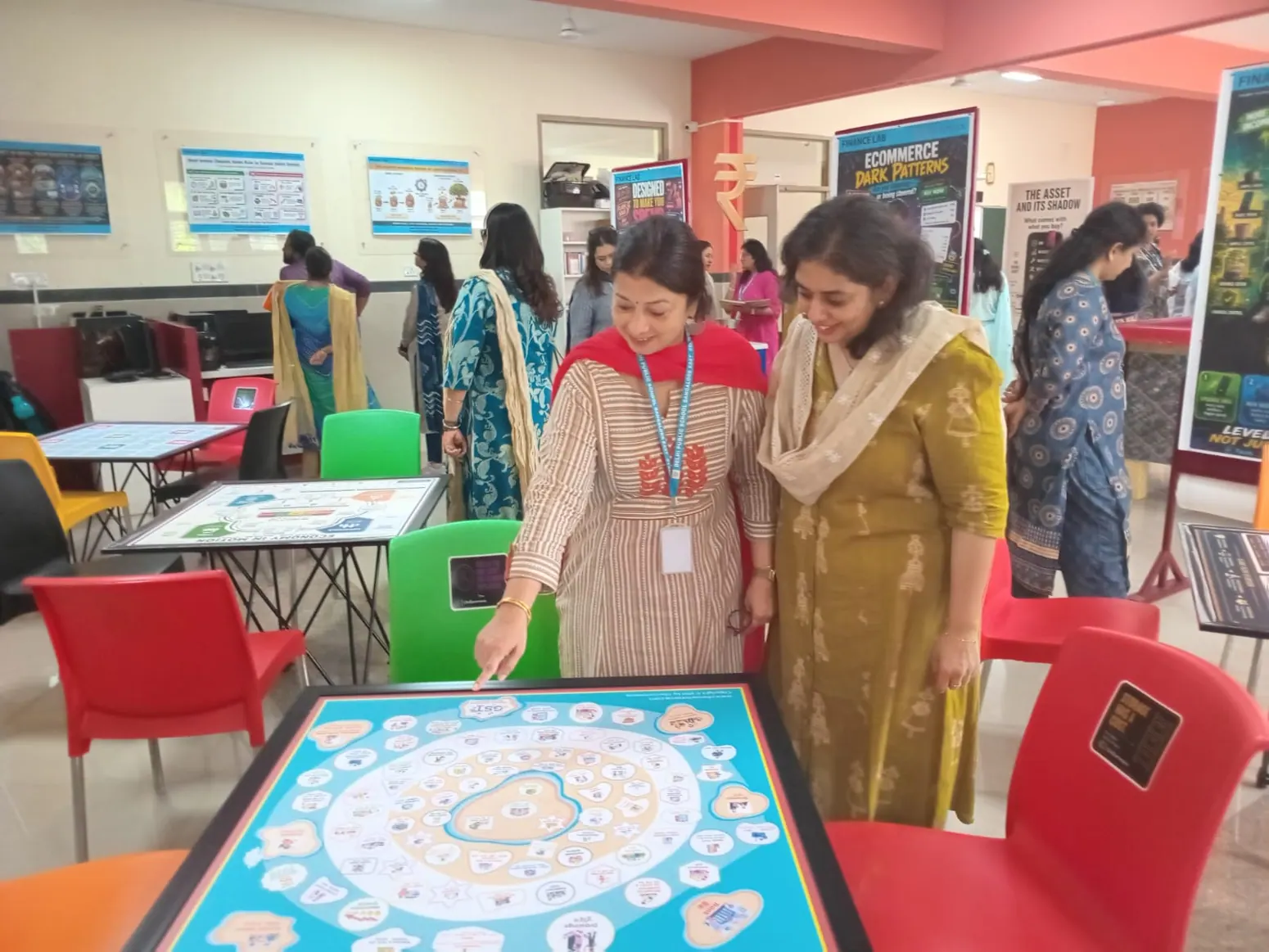
Bring financial life skills, commerce concepts and real-world decision-making into a space built for participation.
Students encounter money, payments, risk, consumer choices and online fraud long before they become adults. A CforCommerce Finance Lab gives schools a structured way to turn these topics – and key commerce concepts – into guided experiences learners can participate in, discuss and remember.
Help learners make sense of everyday money choices, banking, risk, digital payments and consumer decisions.
Give senior learners a practical context for concepts from commerce, economics and entrepreneurship.
Turn financial capability into something students can see, use and talk about – not a one-off awareness session.
The lab is designed around active learning. Students encounter situations, make decisions, compare outcomes and connect the experience back to the concept.
The learning begins with something to do, notice or decide.
Learners compare options instead of waiting for an answer.
Consequences make the concept easier to question.
Different choices create better conversations.
The facilitator links the experience to financial life and classroom learning.
Where space permits, CforCommerce can configure a dedicated Finance Lab as a visible experiential-learning environment.
Sessions can be organised by class, theme, module or school calendar rather than relying on occasional events.
Teachers are introduced to the learning environment and supported in structured use.
Depending on the programme design, participation, learning progress, module completion and certification can be incorporated.
Financial literacy and digital safety can engage middle and senior school learners, while older students can go deeper into commerce, economics and entrepreneurship.
Understand the school, learners, available space and objectives.
Shape the deployment around the approved learning scope and site context.
Create the physical learning environment and prepare the approved resources.
Introduce teachers or facilitators to structured use of the lab.
Plan learner sessions, modules or activity cycles.
Look at utilisation, learning progress and the next stage of use.
Explore selected school implementations and see the learning environment in use.
No single room size is prescribed on the public website. The model is configured after understanding available space, learner volume and the intended level of deployment.
The programme is designed for structured school use, and teacher or facilitator orientation is included according to project scope.
No. Financial life skills and digital safety are relevant across learner groups. Senior students can additionally engage with deeper commerce, economics and enterprise concepts.
Yes, subject to location and host-institution permission. Request a site visit and our team will coordinate an appropriate option where possible.
Tell us about your school, learner profile and available space. We will recommend the next discussion – not ask you to design the solution yourself.